Kindergarten Art Appreciation: Mother and Child · Craftwhack
I am launching a weekly fine art appreciation mail on Artchoo. I am currently transferring my kids' schoolhouse'southward Fine art Appreciation for Kids program from typed-out pages to Ability Signal presentations, and I thought these would exist a fantastic resource for parents and art teachers to have access to. We'll get-go with kindergarten art appreciation.
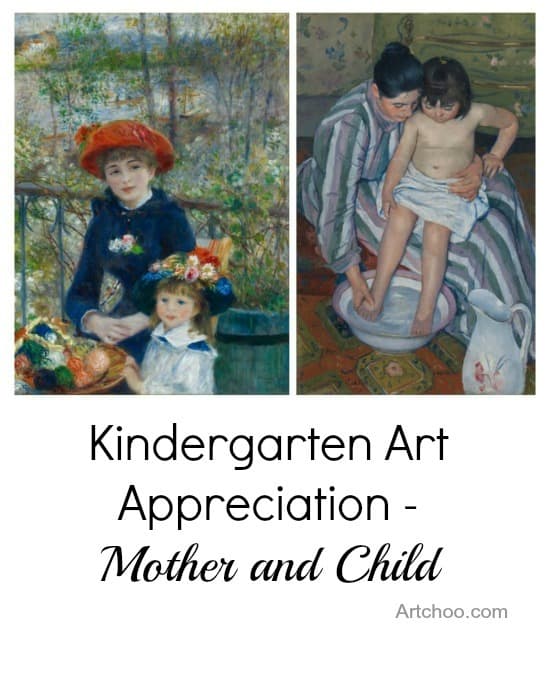
This first presentation is titled Mother & Child, and focuses on introducing the idea of color within artwork to kids. If y'all'd like to download the powerpoint presentation, click hither: K-Motherandchild. Otherwise, you can read through the presentation below and then invite your kids over to your estimator and start talking art!
*****

The Bath, Mary Cassatt, 1891-92, Art Constitute of Chicago
On The Terrace, Pierre Auguste Renoir, 1881, Fine art Institute of Chicago
image sources: The Bath, On the Terrace
Requite the children a few moments to await at these. Identify the paintings past name. Ask the children to name some things they meet in both paintings (female parent, child, flowers, the utilise of colour, shapes, and lines, etc.)
Explain that artists ofttimes paint like subjects, but that each creative person paints a subject in his or her own style. Have the children betoken out some of the differences between the two reprints. (One is an indoor scene; the other outdoors. In one, The Bath, the mother and child seem unaware of the artist; they are concerned only with each other; we are looking down on them. In On The Terrace, the mother and child seem to be posing for the artist and are looking correct at us.
The brushstrokes are quite unlike: The Bath is very smooth and blended; On The Terrace contains rapidly painted dabs of color, specially in the handbasket and in the groundwork. Ask the children to endeavour to determine when the paintings were painted (approximately 100 years ago) and how they can tell (by the clothing; the use of a bowl and pitcher for bathing). Inquire them how this is the same or different than the style we practise things today. Explain that by looking at works of art we tin can ofttimes decide how people lived in the past.
Introducing the element of fine art, colour:
Explain that all artists, even the children themselves, make use of color in their artworks.
Have the children look at On The Terrace and identify the colors that the artist used. The cherry-red hat is non but red, but contains white, black, and orange. This same reddish is repeated in the daughter's lid and in the basket. The blue of the adult female's apparel (even though darker) is similar to the blue in the flowers of the girl'due south hat and collar, and the dejection in the basket, water, and background mountains. The railing and the butt (lower right) are a similar bluish/light-green. The green in the handbasket is repeated in the leaves of the trees.
Help the children to understand that the artist chose these colors and repeated them throughout the painting because the colors looked pleasing together and fabricated a beautiful color composition.
Direct the children to look at The Bath and to identify the colors that the artist used in the female parent's dress. The dress is made up of a cute pattern of stripes: green, white, regal, green white, purple. Ask the children to signal out where else in the painting they see these aforementioned colors. The greenish in the dress is seen in the carpeting, in the wallpaper, and in the dresser backside the mother and kid. White is seen in the pitcher, the child's towel, the wash bowl, the skin tones, and in the flowers of the dresser. Purple is seen in the rim of the wash bowl and in the wallpaper.
Ask the children to name the colors of the flowers on the pitcher (red and blue). Where else do they run into this same crimson and bluish? The red is used in the carpet and the blueish shows up as water in the basin. Remind the children that when mixed together, red and blueish make purple, the same purple in the dress. Help the children to understand that the artist chose these colors and repeated them throughout the painting considering the colors looked pleasing together and made a beautiful color composition.
Groundwork Information (For the presenter):
All artists make use of colour, shape, and line in their artworks. These are called the elements of art. The element of art discussed in this programme is called color. In kindergarten the children should be able to name and place the basic colors (red, blue, yellow, orange, green, purple, white, blackness, brownish).
Most artists work with a 'express pallet', significant they will utilise only a few colors (3 to 6) and blend all their colors for a detail painting from these few colors. This may be too complex to explain to the children. But with that information in mind, we can make the children see the basic colors and variation of those colors repeated throughout the painting. They volition gradually come to understand how the creative person uses color. The creative person doesn't go out all the colors and go crazy. The artist carefully chooses a few colors that work well together. Past controlling the blending of those colors and by controlling the corporeality of each color on the canvas, the artist produces a color limerick that is understandable, sets a sure mood, and is pleasing to the centre. The artist chooses the colors, just similar choosing the discipline affair or the type of textile that is used.
Proffer:
We make choices in the morning about the color of clothes that nosotros put on; we want to wear colors that get together. Ask the children about the color combinations that they like to clothing. Are there some colors that do not go together? The artist makes choices, likewise, in the colors that are used in a painting. We all take favorite colors; ask the children virtually theirs and why they like those colors.
*****
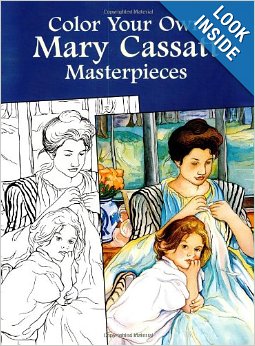
You know what's absurd? I found a Mary Cassatt coloring book! And it includes The Bathroom. How fun would it exist to written report the painting with your kids and then permit them color their own based on what they learned well-nigh color?!
Here are the remainder of the K-5Art History for Kids presentations. I will update them weekly, so check dorsum every Friday!
Source: https://craftwhack.com/kindergarten-art-appreciation-mother-child/
0 Response to "Kindergarten Art Appreciation: Mother and Child · Craftwhack"
Post a Comment