Perissions Set to Default on Win 7 How Can I Gain Access to My Folders Again
Network: Establishing Windows File and Folder Level Permissions
Last updated
In many cases, you will need to alter the permissions that a certain group or private user has to a file or folder. For instance, you can designate a special folder on the W: drive inside your department's expanse called "Incoming" as a place where students tin can turn in their work. To exercise this, you would first demand to create a new folder on the W: bulldoze. By default, the new folder will accept the same permissions equally the parent folder, which would not permit students to submit their work, and may not allow students to even admission the binder. You would then need to allow students access to the new binder, and ready permissions for the folder. When you set up permissions, you are specifying what level of admission students have to the folder and its files and what students tin do within that folder such as salvage, delete, or read files.
Annotation: The majority of these instructions refer to Computer in the Kickoff Menu.
Content
- Standard Permission Types
- Create a New Folder
- Accessing the Properties Dialog Box
- Granting Access to a File or Binder
- Setting Permissions
- Advanced Folder Level Permissions
Standard Permission Types
There are six standard permission types which apply to files and folders in Windows:
- Total Control
- Modify
- Read & Execute
- List Folder Contents
- Read
- Write
Each level represents a different set of deportment users can perform. See the tabular array beneath for more than information.
For folders y'all tin also set your own unique permissions or create a variation on any of the standard permission levels. Within each of the permission levels are many possible variations. For information on some of these advanced options, refer to Avant-garde Folder Level Permissions below.
The following tabular array represents the available standard permission types.
| Permission | Description |
|---|---|
| Full Control | Permits the user(s) to:
|
| Change | Permits the user(due south) to:
|
| Read & Execute | Permits the user(due south) to:
|
| List Binder Contents | Permits the user(s) to:
|
| Read | Permits the user(s) to:
|
| Write | The Read permissions, plus permits the user(s) to:
|
Create a New Binder
In many cases you will need to create a new folder. If you are using an existing binder and exercise not wish to create a new folder, continue with Accessing the Properties Dialog Box.
- Click on the Start bill of fare.
- Click Figurer.
- From the Figurer window, select the shared bulldoze for your area or section (Southward Drive or W Drive).
- Navigate to the location you want the new folder to appear (e.g., within one of your existing folders).
- On the carte bar, select New Folder.
OR
Right click » select New » select Folder.
A new folder is created which inherits the security permissions of its "parent."
- In the newly created folder, type the desired folder name.
- Press [Enter] or click off of the binder.
Accessing the Properties Dialog Box
When working with permissions in Windows 7, yous are required to work from the Backdrop dialog box. This dialog box for the file or folder you are working with can be accessed in a few steps.
- Click on the Start carte.
- Click Estimator.
- Select the binder or file you wish to suit/view permissions for.
- Right-click the folder or file.
- Select Properties .
The Backdrop dialog box appears.
Granting Access to a File or Folder
Later on creating a new folder, or even if you will apply an existing binder, you will need to make up one's mind who volition have admission to it. Also, keep in mind that by default the aforementioned persons who take access to the "parent" (original) folder also have admission to the new folder, and vice versa. This may not be ideal. Information technology is a unproblematic process to grant access to specific users for any folder yous accept created.
- Access the Backdrop dialog box.
- Select the Security tab.
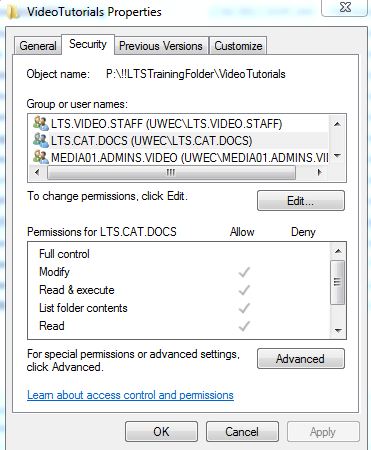
- Click Edit.
The security tab opens in a new window.
- Click Add...
The Select Users, Computers, or Groups dialog box appears.
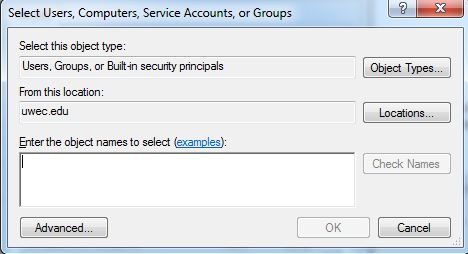
- In the Enter the object names to select text box, type the name of the user or grouping that volition take access to the folder (e.g., 2125.engl.498.001 or username@uwec.edu).
HINT: You lot may type the beginning of the proper name and then click Check Names. The name volition either be resolved or a list of users showtime with those characters volition brandish for y'all to select from.
- Click OK.
The Properties dialog box reappears.
- Click OK on the Security window.
- Continue with Setting Permissions beneath.
Setting Permissions
Once you lot have granted a group or individual user admission to a folder, you will need to fix permissions for the new user(s). When you set permissions, you lot are specifying what level of access a user(s) has to the folder and the files within it. Exist careful about checking Deny for whatsoever permissions, as the Deny permission overrides whatever other related to Allow permissions.
Folder permissions can be changed merely past the possessor of the binder (i.e., the creator) or by someone who has been granted permission by the owner. If you lot are not the owner of the folder or have not been granted permission by the owner, all checkboxes will be grey. Therefore, you volition not exist able to make any changes until the possessor grants you permission.
- Access the Properties dialog box.
- Select the Security tab.
The top portion of the dialog box lists the users and/or groups that accept access to the file or binder.
- Click Edit
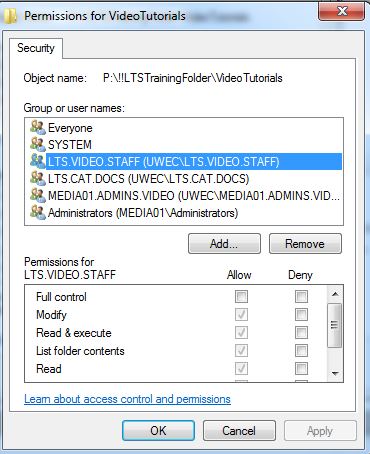
- In the Group or user name section, select the user(s) you wish to set permissions for
- In the Permissions section, use the checkboxes to select the advisable permission level
- Click Apply
- Click Okay
The new permissions are added to the file or folder.
Advanced Binder Level Permissions
When you set permissions, yous specify what users are allowed to do within that folder, such equally relieve and delete files or create a new folder. You are not express to choosing i of the standard permissions settings (Total Command, Change, Read & Execute, List Binder Contents, Read, or Write). Instead of choosing 1 of these settings, you may set up your own unique permissions based on what you would like users to be able to do. For an understanding of how options tin can be combined, refer to Permission Types: An Overview.
Remember, folder permissions can but be changed by the possessor of the binder (i.east., the creator) or past someone who has been granted permission by the owner. If you are not the owner of the folder or have not been granted permission by the owner, the checkboxes will be grayed out. Therefore, you lot will not be able to make whatever changes until the owner grants y'all permission.
- Access the Properties dialog box
- Select the Security tab
- Near the bottom correct of the Properties dialog box, click Avant-garde
The Advanced Security Settings dialog box appears.
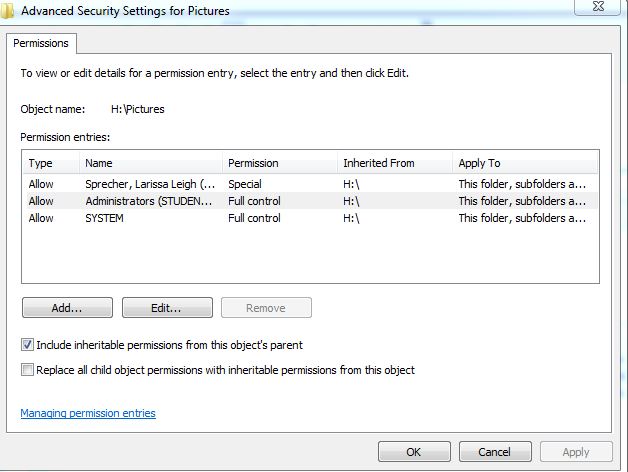
- (Optional) If you do not want the new folder to have the same permissions as the "parent" (original) folder and wish to set unique permissions for the new folder, click the Change Permission push well-nigh the bottom. This volition bring up a similar window.
- Uncheck the Include inheritable permissions from this object's parent checkbox
A Windows Security warning dialog box will appear.
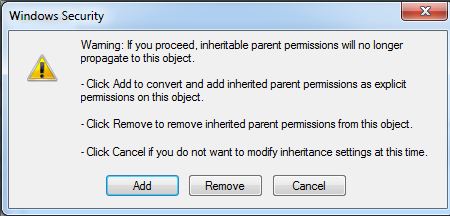
- Click Remove if you lot want someone removed from permission all together
Notation: Read the instructions advisedly and choose the action yous wish to have taken for permissions.
- Uncheck the Include inheritable permissions from this object's parent checkbox
- Click the Change Permissions button
- Select the appropriate user
OR
Click Add and enter the name of the user or grouping that will have access to the folder.
- Click Edit...
The Permissions Entry dialog box appears.
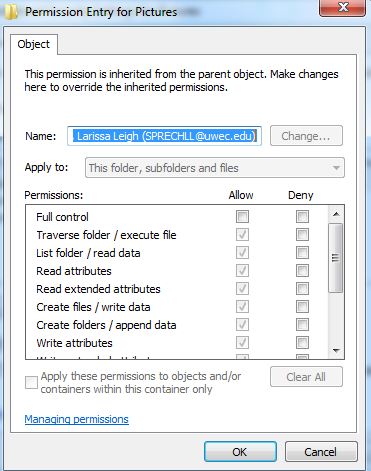
- In the Permissions section, use the checkboxes to gear up the appropriate permissions
Annotation: If yous are not the owner of the folder or accept not been granted permission by the possessor, all checkboxes will be grey. Therefore you volition not be able to brand any changes until the owner grants you permission to do and then.
- From the Apply to: pull-downwardly list, select what level yous wish to employ these permissions to
- Click OK
- In the Avant-garde Security Setting dialog box, click OK
- Click OK from the duplicate Avant-garde Security Settings
- In the Properties dialog box, click OK
The new binder permissions are added for your specified user(s).
Source: https://www.uwec.edu/kb/article/drives-establishing-windows-file-and-folder-level-permissions/
0 Response to "Perissions Set to Default on Win 7 How Can I Gain Access to My Folders Again"
Post a Comment