Continuous Deployment Use Case in Financial Services Industry
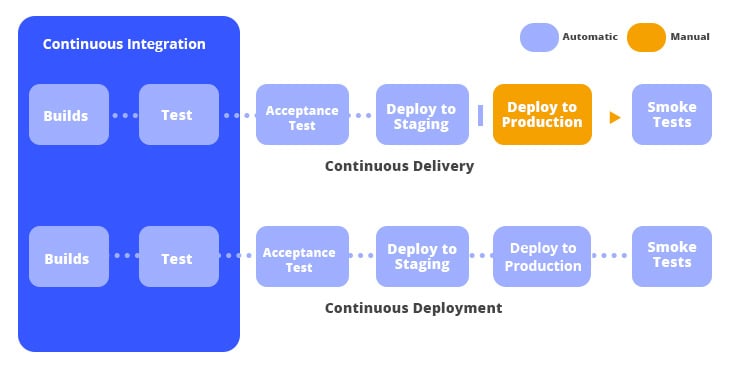
There are some key DevOps practices that enable organizations to automate and streamline the software development processes. Continuous Integration and Delivery (CI/CD), Continuous Deployment, Microservices, Infrastructure as Code (IaC), Containerization, Monitoring & Logging are a few of them. We have already covered some of these DevOps practices in detail in our previous articles. In this one, we will be discussing Continous Deployment, its activities, and tools. Let's get started. With this software development practice, the DevOps teams aim to achieve the following: For continuous deployment, automation is the key. A suite of automated tests is programmed to verify the new code commits are functional. In situations when the tests reveal any unexpected results, the deployment is aborted (with the help of tools) and human intervention is triggered to work around the issues. The two DevOps practices- Continuous Delivery and Continuous Deployment are often considered the same. However, there is a thin line between the two. Let's understand what is it. In Continuous Delivery, the code is ready to be deployed to the production environment. At this stage, the code has passed all the tests to push the code to production but it undergoes a manual verification to confirm if the features meet the expectations and feedback (if any) is provided to the development team. This feedback loop between the users and the developers helps in the continuous improvement of the solution. In Continuous Deployment, the release happens automatically if the code is accepted in the CI/CD phase (Continuous Integration/Continuous Delivery). Organizations are moving beyond continuous integration to continuous delivery deployment. The reason is dynamic business requirements to respond to the market competition. The goal of the DevOps CI/CD pipeline is to deliver software faster and frequently. For consumer-facing businesses, it is important to discover the market needs, develop necessary features, convert the lines of code into functional features, and make it reach the users as fast as possible. In a traditional Agile environment, the developers would have to wait weeks or months to see features in action for the first time. Continuous deployment reduces this time and allows the development team to ship the updates weekly, daily, or even hourly. Frequent releases offer the advantage of involving other teams in the cycle. For example, When the app is frequently updated and launched in the market, the marketing team or the product managers have the opportunity to test if a feature is able to solve the problem of users. When businesses are able to test their innovations frequently, it helps them to validate their approach before investing months on a feature that's not even resolving a real-time problem. Continuous Deployment reduces human intervention in the release cycle. With a rigorous testing environment, the code is tested to the greatest extent possible. Less manual processes mean more work done. However, despite all efforts, issues can occasionally get into the code. But if the code is committed frequently, it means that small changes are pushed to the application. This is helpful in the following ways: In addition to this, frequent updates lead to a shorter feedback loop. With tools for monitoring, the developers are able to assess the impact of the latest release on users, and their behaviors, and make changes accordingly. There are different approaches in a DevOps cycle to adopt automation. Infrastructure-as-Code (IaC) is one of them. IaC involves automating the creation of environments. Instead of manually handling the severs, the configuration is scripted through coding and is stored in version control. The new environments can be brought online without any inconsistencies. In addition to the above-mentioned benefits, continuous deployment enables teams to focus on their development tasks rather than performing repetitive tasks like following manual test scripts, deploying updates, refreshing environments, etc. ALSO READ: A CTO's Guide to DevOps and its Services AWS CodeDeploy is a fully-managed deployment service. It allows automating the software deployments to computing services such as AWS Fargate, AWS Lambda, Amazon EC2, or on-premises servers. Apart from enabling teams to automate the release cycle, the service helps to avoid downtime during deployment and handles complexities while updating the application. Jenkins is an open-source automation platform. It enables the DevOps team to automate parts of SDLC by offering options to build, test, and deploy the solution. Jenkins provides several plugins and provides a web interface to distribute the load on multiple machines. GitLab CI/CD is a part of GitLab that helps to perform all continuous practices including continuous integration, delivery, and pipeline. The platform allows testing, building, and publishing the software without any third-party aid or integration needed. Octopus Deploy enables teams to orchestrate releases and deploy applications. The platform allows the deployment of the application in the cloud or on-premises. It can manage complex deployments for .NET, Java, etc., and advanced deployment patterns. Other popular names in the list include CircleCI, Codeship, TeamCity, Bamboo, etc. These tools offer a wide range of functionality to automate the DevOps cycle, along with deployments. ALSO READ: SAFe vs LeSS vs DaD: Comparing the Three Frameworks to Scale Agile One of the critical aspects of implementing Continuous Deployment is Continuous Testing. Until the code undergoes rigorous testing, the code release cycle cannot be automated. If there is an application for which the DevOps cycle needs to be automated, then technical help is available to your businesses through our DevOps experts. All you need to do is- connect with them. A consultation call with the domain experts will give you an idea of how the code release cycle can be automated for your business application, what are the complexities involved, how to avoid or nullify downtime, etc. It's a no-obligation consultation. So book your appointment now to get started with the automated development cycle.
What is Continuous Deployment to Production?
Continuous deployment is a software development strategy where a new code or a change is deployed directly to the production environment after going through a set of rigorous, automated tests. The changes in the software (after deployment) are visible to the end-users of the application.
The Fine Line Between Continuous Delivery and Continuous Deployment
Continuous Deployment: Why is it Important?
List of Continuous Deployment Tools
Conclusion:

Written by
Content strategist by profession and blogger by passion, Archna is avid about updating herself with the freshest dose of technology and sharing them with the readers. Stay tuned here as she brings some trending stories from the tech-territory of mobile and web.
Source: https://insights.daffodilsw.com/blog/what-is-continuous-deployment-in-devops
0 Response to "Continuous Deployment Use Case in Financial Services Industry"
Post a Comment